I have these available now for $75, shipping included, via Paypal. Email me at ellindsey@gmail.com for details.
Thursday, May 20, 2010
For those who wanted one
I have these available now for $75, shipping included, via Paypal. Email me at ellindsey@gmail.com for details.
Monday, May 17, 2010
An experimental servo modification holds up for the Steampunk World's Faire
After the gears, the next weak spot in the HX-12K servos is the case. I cracked several mounting tabs at GenCon last year. That problem seems to have gone away once I switched to larger rubber grommets around the mounting screws, and made sure all four screws were evenly tightened to spread the load. One servo cracked where I had installed a rear hinge point on the case, but that appears to have been an isolated case, probably due to assembly error on my part.
The main failure point now is the mounting of the axle shafts inside the gearbox. The gearbox main shaft is mounted by two ball bearings. I've yet to see that fail. The smaller hears inside the gearbox are located by two smaller shafts, which fit into plastic pockets in the gearbox housing. More expensive servos have brass bushings or even small ball bearings for the intermediate gear shafts, but the HX-12K and even the more expensive HS-5645MG servos have bare plastic there. I have seen on many servos, the HX-12K in particular, these mounting holes widened and even gouged out, allowing the middle gear in the servo to wobble back and forth. This lead to the geartrain coming unmeshed, locking solid, or even in one case a gear wandering into the side of the gearbox housing and gouging grooves in it.
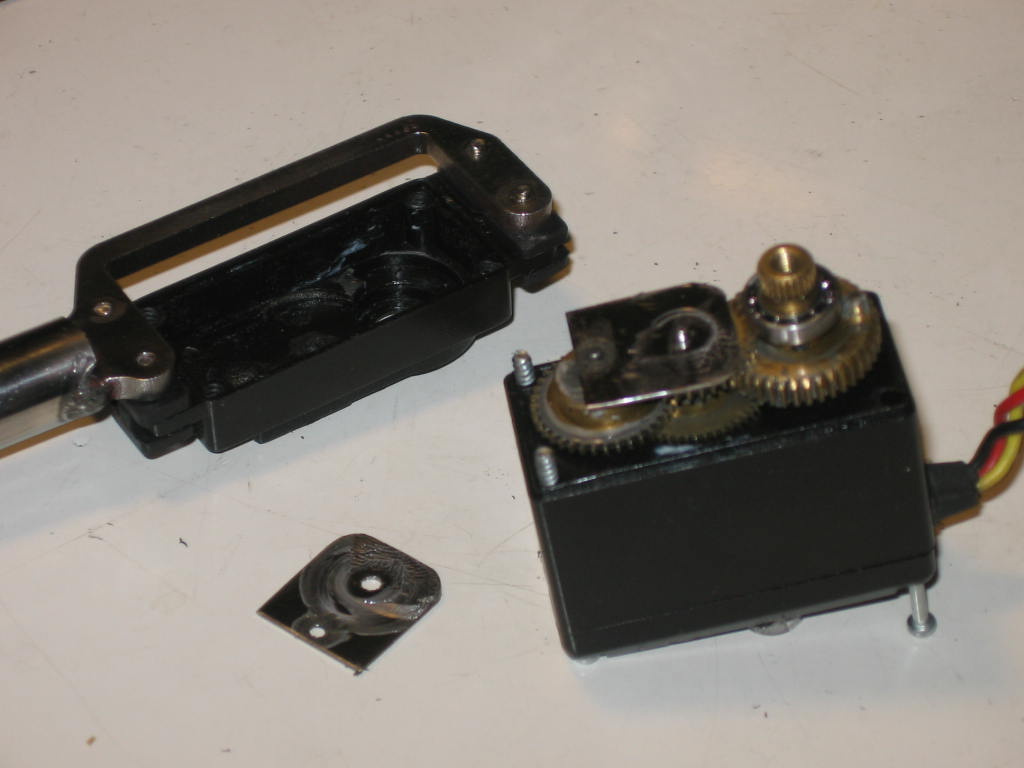
As an experiment I took a few servo cases that were already trashed this way and carefully shaved out all remains of shaft mounting on the inside of the case. Then after carefully measuring an intact servo, I drilled and cut some .020 steel sheet to make locating plates to hold the top ends of the two intermediate shafts. Cutting and drilling by hand, it took several tries to make the locating plate precise enough for the gears to mesh properly and for the servo to run smoothly when reassembled. When the first servo I modified this way ran well during testing, I modified three more.
All four of the outer leg servos on the robot, the ones which raise and lower the leg segments, are now heavily modified hybrid models, having motors and control boards from HS-5645MG servos, the gears from HX-12K servos, and HX-12K cases modified with rear axle points and steel plates locating the intermediate gear shafts. The inner servos, which move the legs horizontally, don't seem to fail nearly as often, so I haven't modified them as much yet.
Sunday, March 28, 2010
Pendants are coming along, and mix-and-match servos
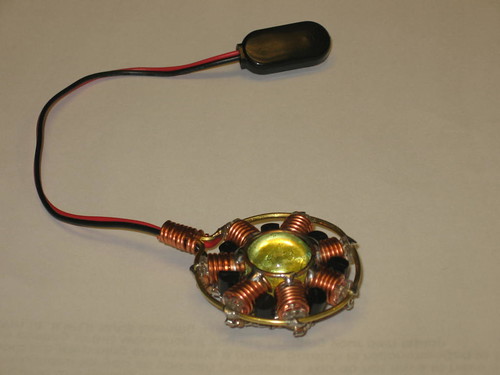
I have five more of the LED uranium-ball ring-circuit pendants finished and ready for sale. While my eventual goal is to have a dozen or so ready for the steampunk world's faire, I am aware that I had a backlog of people wanting theirs. Contact me if you were one of those.
I've been running the robot with HS-5645MG servos lately. I'm not happy with them. While they don't have the terrible problems with ringing and overshoot that the HX-12K servos had, they do have a weak gearbox design. The second-to-last gear in the gear chain is surprisingly thin. I've lost track of how many gears I've seen break on these servos, always in the exact same spot. The HX-12K servos had a much thicker gear in that same position, and I've never seen one fail that way. HX-12K servo failures I've seen tend to be electrical board or motor failures, or structural failures in the servo case.
I am experimenting with building a composite servos using the motors, potentiometers, and drive boards from the HS-5645MG servos and the gear train from the HX-12K servos. They have nearly the same gear ratio, and appear to have the same spacing between gears and same size shafting. There are some odd clearance issues. The HX-12K gears jam when installed in the HS-5645MG cases, although the HS-5645MG gears run fine in the HX-12K cases. I have installed the motors, drive boards, and potentiometer from a HS-5645MG in a HX-12K case with the HX-12K geartrain. The potentiometer is a tight fit and doesn't turn smoothly if I tighten the case screws tightly, but other than that the arrangement works.
The weak link is still the HX-12K case. The mounting tabs break off, the case itself cracks, and I've seen a few cases of total failure of the mounting boss for the small internal shafts inside the gearbox. Making my own cases from cast aluminum is out of the question in the condo, and having cases custom-machined would be unreasonably expensive. If I had that kind of budget, I would just buy higher-quality servos in the first place. Still looking for other options.
Sunday, February 21, 2010
Exhibition at Wicked Faire
Yesterday I took the walking robot to the Wicked Winter Renaissance Faire to show off and entertain with. The trip was quite successful, with many fairgoers entertained. Unfortunately the problems I've been having with the HS5645MG gearboxes resurfaced. In this version I was running with hybrid servos containing the electronics, motors, and gears from HS5645MG servos installed in HX12K servo cases. HX12K cases were used simply because the ones I had were already fitted to the robot frame, and because I didn't have enough intact HS5645MG servo cases. HS5645MG servo innards were use because the HX12K servos had terrible position control and easily burned out motors.
Over the course of the day I had two gear failures. Both of them were identical to the failure I've seen before, with the second-to-last (counting from the motor) gear in the gear train losing teeth. This gear is surprisingly thin for the torque it's carrying. The same gear in the HX12K servo is significantly thicker, and in my robot has never failed.
I had spare gear sets on hand and was able to repair the damage and keep the robot going, but this is an unacceptable and expensive failure rate. I believe it may be possible to construct a hybrid servo using the gears from the HX12K and the motor and control board from the HS5645MG, which if it worked would give me the solid position control of the HS5645MG and the durability of the HX12K. Once the weather improves I will start working on that.
The other failure, which stopped my showing off the robot for the night, was when the antenna broke off the transmitter. The wire antenna that can come attached to the XBee radio module is made out of some very cheap and brittle coarse-stranded wire. I had long ago replaced the wire antenna on the receiver with a length of ultra-flexible wet noodle wire. Now I'll be doing the same with the transmitter.
I sold a few of the Uranium Ring Oscillator Pendants I've made at the faire, and had enough interest from people in them that I've set up an Etsy account. There's nothing much there now, but when I have some more jewelry made I'll be posting it there.
Monday, December 28, 2009
Walking again for the holidays
For demonstrations at various parties and family gatherings over the holidays I have rebuilt the walking robot. The issues which arose with the robot over the summer appeared to be due to the unsatisfactory reliability and poor accuracy of the cheap HX12K / MG995 servos. The combination of the higher than recommended voltage and amble gait was too much for the motors, which were failing frequently, but what was most unacceptable was the terrible servo feedback loops which made the entire robot shake uncontrollably when trying to hold a leg in the air.
I can't afford to buy 8 new higher-quality servos at the moment, and most of the choices of servos designed for operation above 6 volts would require significant redesign of the entire robot. I did have on hand the 8 HS5645MG servos used on the previous version of the robot. I had stopped using them because of the high rate of gearbox failure in that design, but the electrical and structural failure rate of the HX12K servos was a lot worse. I had also cut the mounting flanges off all those servos as on the previous version I was epoxying the servos to the robot structure.
The new chassis needs servos to be mounted by their mounting tabs, so I couldn't use the old servos as-is. Here I was in luck. Dissassembly and comparison of the HS5645MG and HX12K reveals them to be suspiciously similar internally. The HX12K / MG995 appears to be basically a cheap knockoff version of the HS5645MG, similar enough that I was able to take the electrical and mechanical guts of the HS5645MG and install them inside a HX12K case. I haven't figured out a way to use the HX12K gear train with the HS5645MG electronics and motor yet, so I'm still using the more fragile HS5645MG gears. The gears have the same pitch diameters and axles, which lets me install the gears from one servo in the case of another, but the tooth count is different so I can't mix build a hybrid gear train from both.
The HX12K does have somewhat flimsy mounting tabs, several of which failed at GenCon. For the rebuild I dug through my junkbox and found the largest rubber grommets and ferrules I had, in an attempt to spread the load out as much as possible. This is admittedly a temporary solution. I am still looking into ways to reinforce the servo cases where they mount to the frame.
One surprise when wiring up and testing everything is that the HX12K and HS5645MG seem to have the opposite direction of movement in response to servo commands. When adjusting the mixing logic and pre-programmed poses in the controller I'm having to change signs and invert position settings throughout the code. Although it's possible this is the result of something I did when rebuilding the servos and robot - I might have accidentally reversed the connections between servos on the left and right sides of the robot or something.
At the moment the robot seems to be working well, and held up for several days with family and friends through the holidays. I haven't stripped any more gears yet, but it remains to be seen if this is just a matter of time, or if the shock absorbers and other structural design improvements are actually making a difference.
Saturday, October 31, 2009
Shiny uranium bauble
My project for this weekend was to build a little decorative bauble, a piece of electronic jewelry. Seven high-brightness UV leds driven by a ring oscillator circuit arranged around a uranium-glass marble. You can see a few pictures of it here.
Some of you may recognize this as being similar to the power indicator on my walking robot. The difference with this piece, other than being stand-alone, is that the LEDs are made to flash sequentially rather than being on all the time. It makes it a lot more eye-catching.
Several of my friends are encouraging me to make and sell these as steampunk jewelry. That might end up being the only way I can afford new servos for the robot.
Friday, October 30, 2009
Looking for servos...
The 2009 version of my walking robot was in part a test of the feasibility of using the cheap MG995 servo in a walking robot. I expected that even if these cheap servos didn't last long their cheapness meant replacing them wouldn't be unreasonably expensive. These servos lasted long enough in practice (although when they failed the failure mode what not what I expected) but their terrible position-holding ability made them unacceptable for what I'm trying to do. So the MG995 servos have to go.
I'm currently rebuilding the robot with some HS-5645 servos I have on hand, but I don't expect those to last long. One already has a stripped gear set, and the others don't look they have much life left in them.
I need new servos. Preferably metal-geared servos with motors rated for 7.4V lithium battery use. Unfortunately I'm also on a very tight budget for robots at the moment. My wife will only approve buying expensive servos if I can guarentee they will never fail, and who can guarentee that?
There's the HSR-8498HB. The low-end 7.4V robot servo from HiTec. Not cheap at $60, and a little less torque than the HS-5645MG. It has Karbonite gears, whose durability I would be very concerned about. The HSR-5498SG has steel gears, better torque, and is only slightly more expensive at $70. Both these servos are available with a rear axle point built into the case, which would remove the need for me to modify the case that way. On the downside these do not use the standard servo mounting points, which means they would not be useable with the current waterjet frame pieces. Although since all the strucural failures I had were at the standard mounting points, redesigning the servo-to-frame attachment method might be a good idea.
There's the $60 HDS-2288. Metal gears, rated for 7.4V, nice torque, uses standard servo mounting points. I'm not sure if they're actually available with any reliability, they seem to be sold out or on backorder everywhere.
The $20 Associated SHV1504MG has metal gears and is rated for 7.4V, and uses a standard servo case, but is terribly underpowered for this requirement.
Then Dynamixel servos. These look really interesting, having some amazing features way beyond normal servos in how they can be configured and what kind of feedback data you can get back from them. These don't use the standard servo control pulses at all, but instead have an addressed serial bus scheme, which I should be able to connect straight to the serial ports on the Xbee radio. I could use this to feed back voltage and temperature indications to the controller, maybe even translate joint torque into force-feedback somehow. Very interesting possibilities. And all these servos will run at 7.4V. They're actually designed for 9.6V, so 7.4V is a little on the low side but still within the rated voltage range.
On the down side most of the Dynamixel servos are completely outside my price range. The $45 AX-12 servo I could probably afford, but those have plastic gears which I'd prefer to avoid. The Dynamixel servos also would require a complete strucural redesign to use. That might be a plus after all, the AX-12 servos are far better suited to robotics from a strucural point of view than are standard hobby servos.
The last option would be to just make some frankenstein hack from my current servos, homemade die-cast cases, openservo boards, and rewound motors. Considering that as a backup plan.
I'm currently rebuilding the robot with some HS-5645 servos I have on hand, but I don't expect those to last long. One already has a stripped gear set, and the others don't look they have much life left in them.
I need new servos. Preferably metal-geared servos with motors rated for 7.4V lithium battery use. Unfortunately I'm also on a very tight budget for robots at the moment. My wife will only approve buying expensive servos if I can guarentee they will never fail, and who can guarentee that?
There's the HSR-8498HB. The low-end 7.4V robot servo from HiTec. Not cheap at $60, and a little less torque than the HS-5645MG. It has Karbonite gears, whose durability I would be very concerned about. The HSR-5498SG has steel gears, better torque, and is only slightly more expensive at $70. Both these servos are available with a rear axle point built into the case, which would remove the need for me to modify the case that way. On the downside these do not use the standard servo mounting points, which means they would not be useable with the current waterjet frame pieces. Although since all the strucural failures I had were at the standard mounting points, redesigning the servo-to-frame attachment method might be a good idea.
There's the $60 HDS-2288. Metal gears, rated for 7.4V, nice torque, uses standard servo mounting points. I'm not sure if they're actually available with any reliability, they seem to be sold out or on backorder everywhere.
The $20 Associated SHV1504MG has metal gears and is rated for 7.4V, and uses a standard servo case, but is terribly underpowered for this requirement.
Then Dynamixel servos. These look really interesting, having some amazing features way beyond normal servos in how they can be configured and what kind of feedback data you can get back from them. These don't use the standard servo control pulses at all, but instead have an addressed serial bus scheme, which I should be able to connect straight to the serial ports on the Xbee radio. I could use this to feed back voltage and temperature indications to the controller, maybe even translate joint torque into force-feedback somehow. Very interesting possibilities. And all these servos will run at 7.4V. They're actually designed for 9.6V, so 7.4V is a little on the low side but still within the rated voltage range.
On the down side most of the Dynamixel servos are completely outside my price range. The $45 AX-12 servo I could probably afford, but those have plastic gears which I'd prefer to avoid. The Dynamixel servos also would require a complete strucural redesign to use. That might be a plus after all, the AX-12 servos are far better suited to robotics from a strucural point of view than are standard hobby servos.
The last option would be to just make some frankenstein hack from my current servos, homemade die-cast cases, openservo boards, and rewound motors. Considering that as a backup plan.
Subscribe to:
Posts (Atom)